August 25, 2026
In my first post, I wrote about why I chose the Peace Corps, why I am interested in agriculture and food security, and why I am heading to Madagascar for the next 27 months.
But that leaves another fairly important question:
What is Madagascar actually like?
When I tell people where I am going, I tend to get one of a few reactions. Some immediately think of lemurs. Others think of the animated movies. And quite a few people know Madagascar is an island but are not entirely sure where to find it on a map.
I will admit that before beginning this process, there was plenty I did not know either.
So, before this blog becomes a record of my experiences in Madagascar, I wanted to establish a starting point: a little about the geography, people, history, agriculture, economy, government, and wildlife of the country I will soon call home.
I fully expect that 27 months from now I will understand all of this very differently.
First, Where Is Madagascar?
Madagascar sits in the Indian Ocean off the southeastern coast of Africa, directly east of Mozambique and separated from the African mainland by the Mozambique Channel.
Its neighbors across the western Indian Ocean include Mozambique, the Comoros and Mayotte to the northwest, the Seychelles farther north, and Mauritius and Réunion to the east.
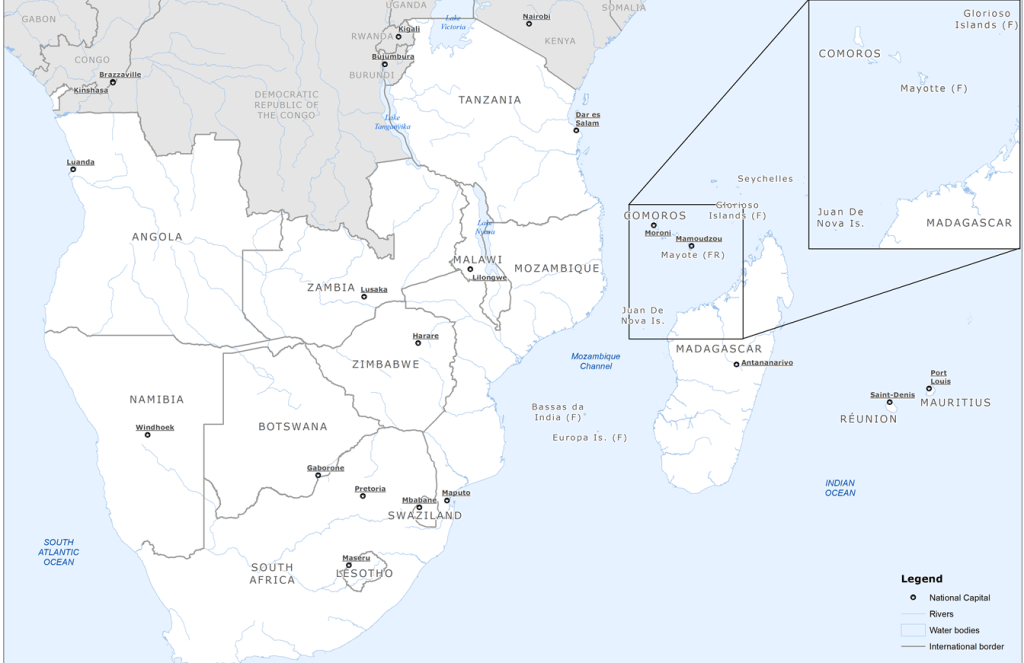
Madagascar’s location off the southeastern coast of Africa in the western Indian Ocean. Map: JRC, European Commission, 2014, via Wikimedia Commons (CC BY 4.0).
And it is big.
At approximately 587,000 square kilometers, or 227,000 square miles, Madagascar is the fourth-largest island in the world, behind Greenland, New Guinea, and Borneo.[1]
From north to south, the island stretches roughly 1,600 kilometers, or about 1,000 miles. At its widest, it is roughly 570 kilometers, or 350 miles, from east to west.
For an American comparison, think Texas.
Madagascar is somewhat smaller geographically than Texas, but the comparison is surprisingly close in another way: Madagascar has a population of roughly 33 million people, putting its population in roughly the same range as Texas as well. The United Nations estimated Madagascar’s 2025 population at about 32.7 million.[2]
The capital, Antananarivo—often shortened to Tana—sits in the central highlands. The United Nations estimated the capital’s urban population at roughly 3.2 million people in 2025.[2]
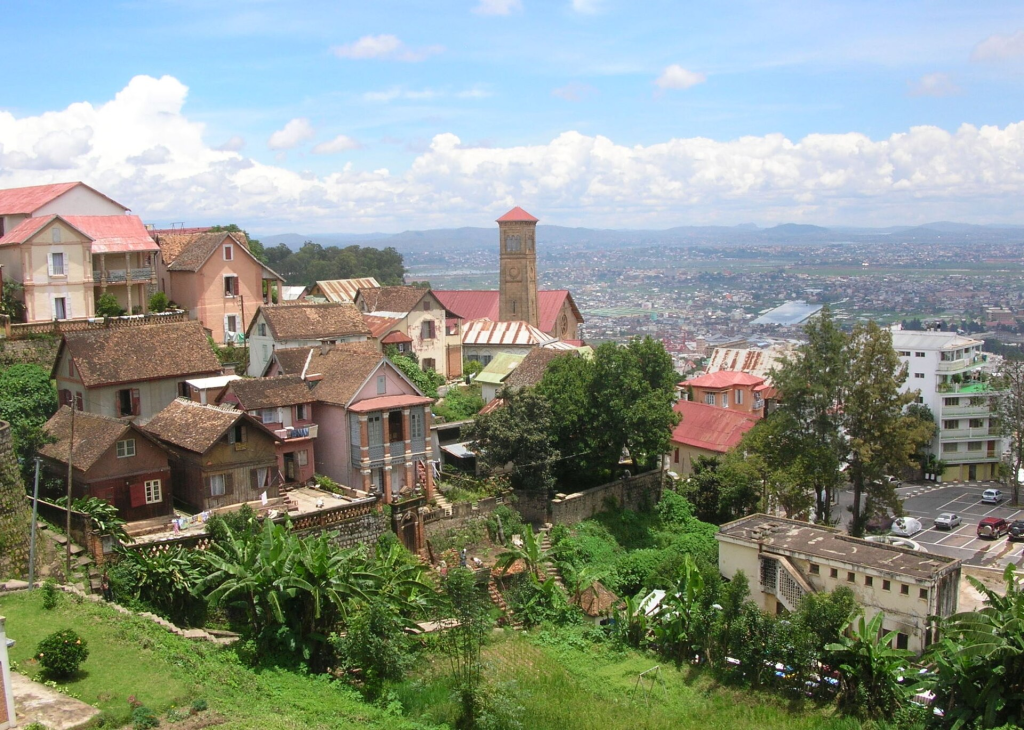
Antananarivo, Madagascar’s capital, viewed from the city’s upper districts. Photo: Bernard Gagnon, 2007, via Wikimedia Commons (CC BY-SA 3.0).
So although many of the images Americans see of Madagascar involve rural villages, rainforests, or wildlife, it is important to remember that Madagascar is also home to major cities and a rapidly growing urban population.
A Tropical Island With Several Very Different Climates
Madagascar lies mostly within the tropics, but being in the tropics does not mean the entire country is hot rainforest.
Its combination of latitude, elevation, mountains, and prevailing winds creates dramatically different environments across the island.
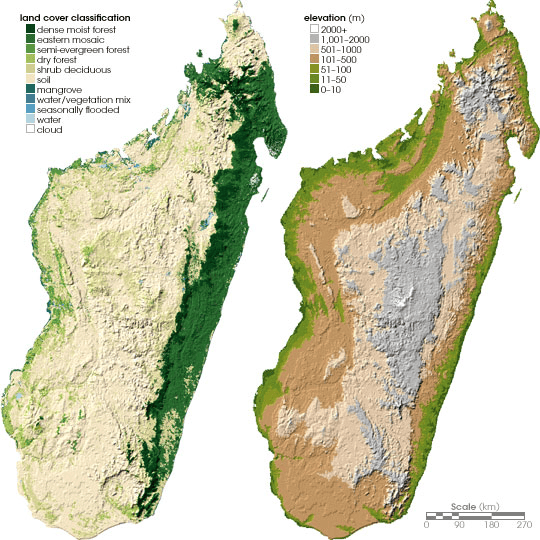
Madagascar’s land cover and topography. The eastern side of the island is much more heavily forested, while the central highlands form a broad elevated spine through the country. Image: Robert Simmon/NASA, 2004, via Wikimedia Commons (public domain).
The eastern coast is generally hot, humid, and wet. Moist air arrives from the Indian Ocean, helping support Madagascar’s tropical rainforests.
Moving inland, the land rises into the central highlands, where elevation produces considerably cooler temperatures. Antananarivo sits more than 1,200 meters—or roughly 4,000 feet—above sea level. Nights there can become surprisingly cool.
The west is generally warmer and drier, with dry deciduous forests and broad plains.
The south and southwest become drier still. Parts of southern Madagascar are semi-arid, and this is where one of the country’s most distinctive ecosystems—the spiny forest or spiny thicket—is found.[1]
Madagascar generally has a warmer, wetter season from roughly November through April and a cooler, drier season from May through October, though what those seasons actually look like varies considerably by region.
The island is also exposed to tropical cyclones, particularly along the eastern side of the country.
Where Peace Corps eventually places me will therefore make a tremendous difference in what my own version of “living in Madagascar” looks like.
Malagasy: One Language, Many Ways of Speaking It
The country’s two official languages are Malagasy and French.
Malagasy is remarkable in part because it is spoken throughout an island this large. One CIA estimate puts Malagasy use at about 99.9% of the population, while French is spoken by roughly 24%. French remains important in government, education, business, law, and other formal settings.[3]
Malagasy also has an unexpected linguistic history.
It belongs not to the Bantu language family common across much of eastern and southern Africa, but to the Austronesian language family. Its closest relatives are found thousands of miles away in Southeast Asia, particularly around Borneo.
There is no simple number of “Malagasy dialects.” Madagascar traditionally recognizes 18 major ethnic groups, each associated with regional identities and speech varieties, but the linguistic reality is considerably more complicated. Researchers have identified more than 20 major dialects and many more localized varieties.
That is particularly relevant to me because I will begin learning a standard form of Malagasy during training and may then need to adapt to the regional Malagasy spoken at my permanent site.
In other words, passing language training will be the beginning rather than the end of learning the language.
Madagascar Before People
Madagascar’s unusual natural history began long before humans arrived.
The land that became Madagascar was once part of the ancient supercontinent Gondwana. It separated from Africa more than 100 million years ago and eventually separated from the Indian landmass as well.
That long period of geographic isolation is one of the major reasons the island developed such unusual plants and animals.
Humans arrived much, much later.
The exact timing continues to be studied, but Madagascar appears to have been permanently settled during the first millennium CE. Some of its earliest settlers made an extraordinary journey across the Indian Ocean from Southeast Asia, while migrants from eastern Africa also contributed substantially to the population.
Over centuries, additional African, Austronesian, Arab, Persian, Indian, and European connections helped shape Malagasy society.
The result is a country geographically part of Africa but also deeply connected historically to the wider Indian Ocean world.
Kingdoms, Colonization, and Independence
Before European colonization, Madagascar was home to numerous kingdoms and political societies.
By the late eighteenth and early nineteenth centuries, the Merina Kingdom of the central highlands became increasingly powerful. Under rulers including Andrianampoinimerina and his son Radama I, Merina authority expanded across much of the island, although control was never equally complete everywhere.
During the nineteenth century, Madagascar became increasingly connected to Britain, France, missionaries, merchants, and the wider international economy.
France eventually invaded.
French forces captured Antananarivo in 1895, and in 1896 Madagascar was formally annexed by France. The monarchy was subsequently abolished, and Queen Ranavalona III was sent into exile.[4]
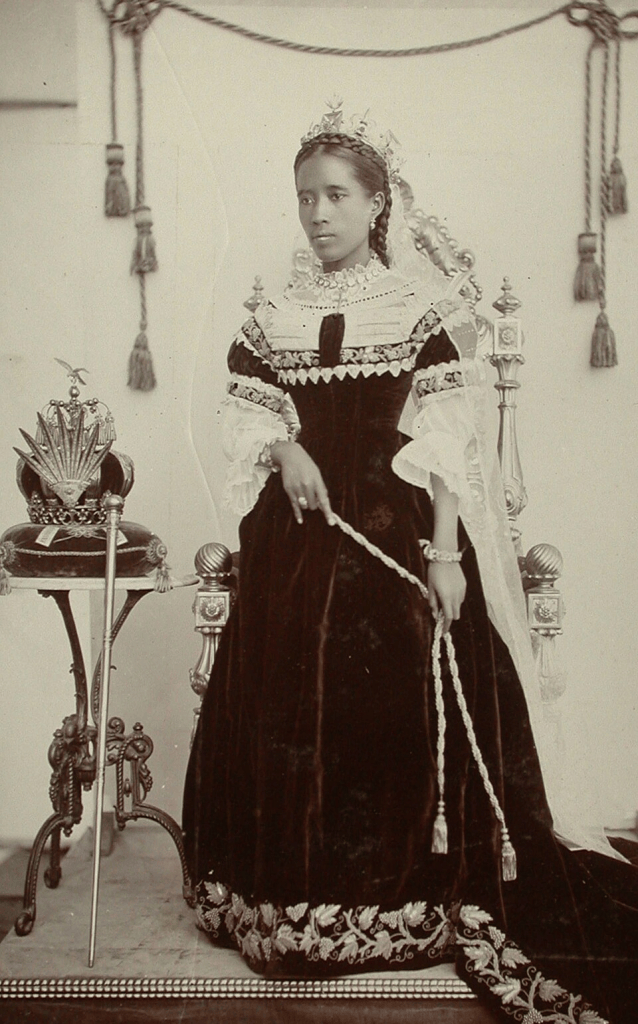
Queen Ranavalona III, the last sovereign of the Kingdom of Madagascar, photographed in Antananarivo around 1890–1895. Her reign ended following the French conquest and annexation of Madagascar. Photograph: unknown author, via USC Libraries and Wikimedia Commons (public domain).
Resistance to French rule continued, including the Menalamba rebellion immediately following conquest and later nationalist movements.
One particularly important moment came with the Malagasy Uprising of 1947, an anticolonial revolt that was violently suppressed by French authorities.
After World War II, however, pressure for self-government continued to grow.
Madagascar became an autonomous republic within the French Community in 1958 and achieved full independence on June 26, 1960—a date still celebrated each year as Independence Day.[4]
The decades since independence have included democratic experiments, socialist government, political crises, disputed elections, and changes of government.
The country’s most recent major political upheaval came in 2025, when protests that began over electricity and water shortages expanded into a broader anti-government movement. President Andry Rajoelina was impeached and fled the country, and the military took power under Colonel Michael Randrianirina. A transitional government was subsequently established with the stated intention of eventually returning the country to elections.[5]
So I will actually be arriving in Madagascar during a particularly interesting period in its modern political history.
How Does the Government Work?
Under Madagascar’s constitutional system, the country is structured as a semi-presidential republic.
Normally, power is divided between a president, who serves as head of state, and a prime minister, who leads the day-to-day work of government.
The legislature has historically been bicameral, consisting of a National Assembly and a Senate, while the judiciary and High Constitutional Court have their own constitutional roles.
Local government extends downward through regions, districts, communes, and ultimately communities.
One particularly important institution at the local level is the fokontany.
A fokontany is a basic local administrative and community unit—something I expect I will become much more familiar with once I am actually living at my permanent site.
The current political transition complicates that normal constitutional structure. As of the time I am writing this, Colonel Michael Randrianirina is serving as president and Mamitiana Rajaonarison as prime minister, while Madagascar moves through a transitional period.[6]
Given that politics can change much faster than a blog post, this may be one section worth revisiting later.
Agriculture: Much More Than Vanilla
For me, this may be the most important section.
Agriculture is central to Malagasy life and the national economy, particularly in rural areas. Roughly seven out of ten employed Malagasy people work in agriculture.[2]
And if there is one crop that towers over Malagasy food culture, it is rice.
Rice—vary in Malagasy—is the major staple across much of the country. Rice paddies are particularly characteristic of the central highlands, although rice is grown in many regions.
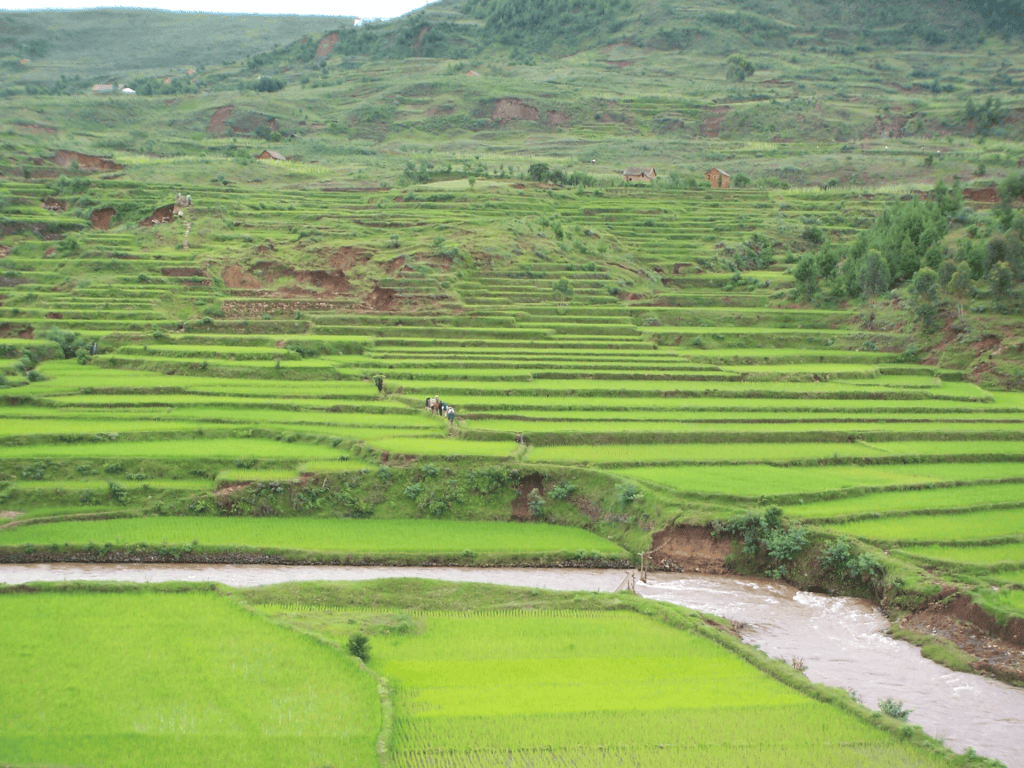
Rice paddies in Madagascar, where rice is a central staple food and one of the country’s most important agricultural crops. Photo: Luc Legay, 2007, via Wikimedia Commons (CC BY-SA 2.0).
Other important food crops include:
- cassava
- maize
- sweet potatoes
- potatoes
- beans and other legumes
- vegetables
- bananas and other fruits[7]
What farmers grow varies considerably with climate and region.
Madagascar also produces internationally important cash crops, particularly vanilla and cloves, along with coffee, cocoa, pepper, lychees, and others. Vanilla and cloves account for a particularly large share of Madagascar’s agricultural exports.[8]
Vanilla is probably the best-known example. Much of the country’s vanilla production is concentrated in the humid northeast, especially the SAVA region.
Livestock is important as well, especially zebu cattle, recognizable by the large hump over their shoulders. Zebu are much more than simply livestock: they have economic, agricultural, social, and cultural importance in many Malagasy communities.
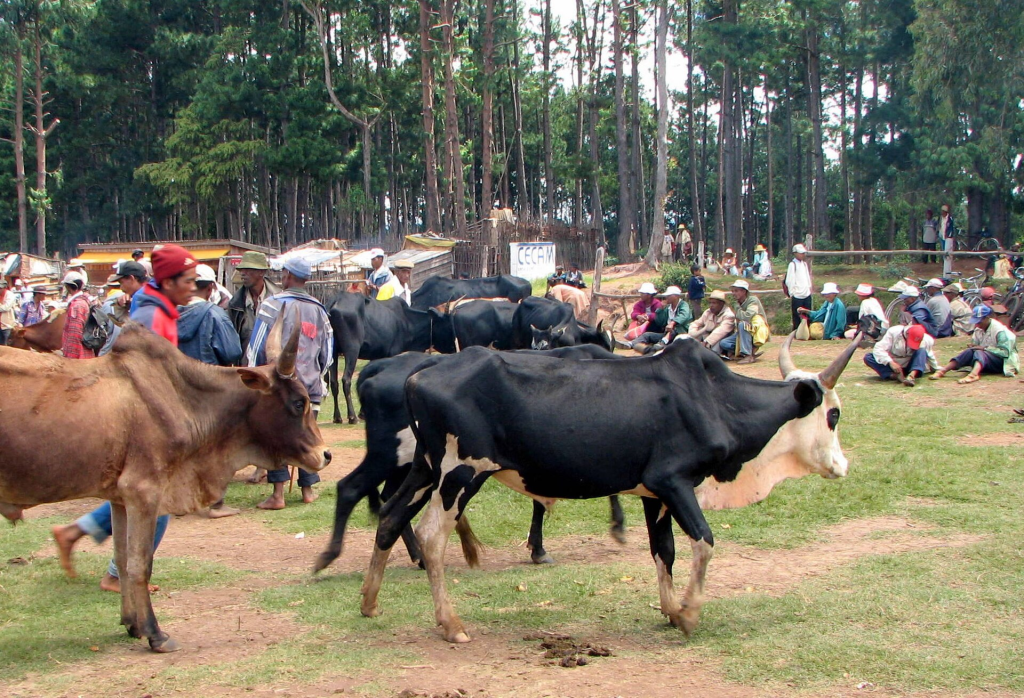
Zebu cattle at the market in Ambatolampy, Madagascar. Zebu play important agricultural, economic, and cultural roles in Malagasy life. Photo: Bernard Gagnon, 2007, via Wikimedia Commons (CC BY-SA 3.0).
I expect I will write considerably more about all of this once I am there.
What Does Malagasy Food Look Like?
The simplest answer may be:
Rice and something to go with it.
Rice forms the center of many Malagasy meals. The accompaniment is often called laoka and might include vegetables, beans, meat, fish, greens, or sauces depending on the region, household, season, and available ingredients.
Two well-known dishes are romazava, a broth or stew commonly made with meat and leafy greens, and ravitoto, traditionally made from crushed cassava leaves and often served with pork.
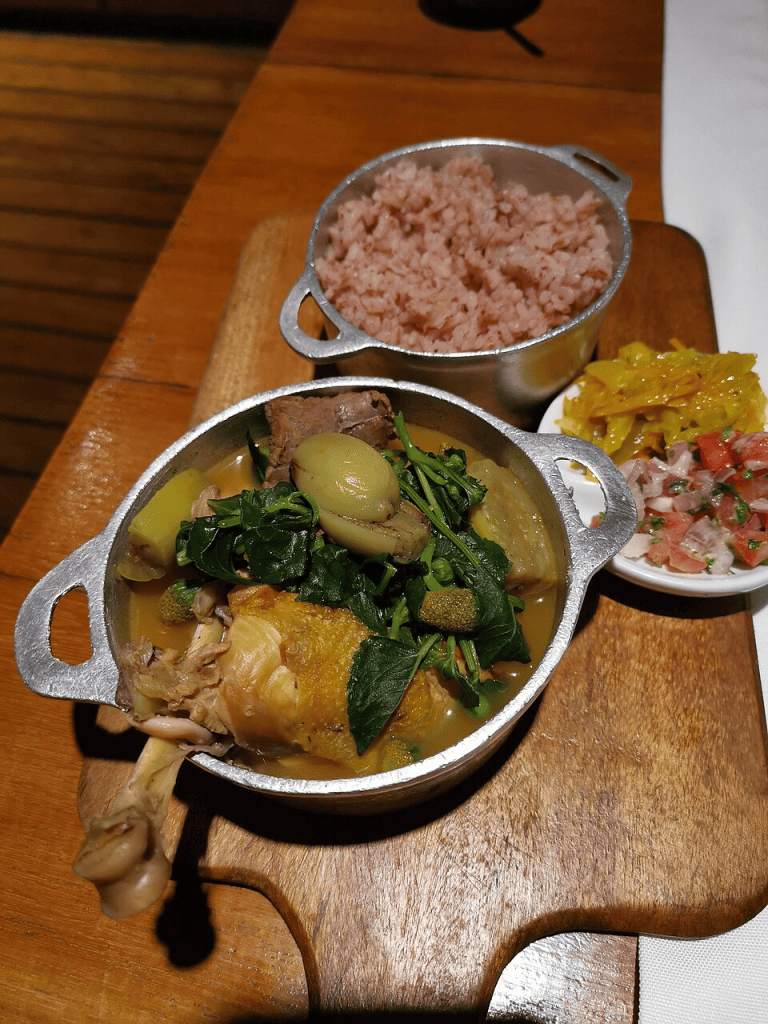
Romazava served with red rice in Madagascar. Romazava is a traditional Malagasy stew, and rice forms the foundation of many meals across the country. Photo: Z thomas, 2019, via Wikimedia Commons (CC BY-SA 4.0).
Cassava, maize, sweet potatoes, beans, peanuts, leafy greens, fruit, fish, and zebu also feature in diets around the country.
Coastal food naturally differs from highland food, and the foods available in a rural agricultural community may be quite different from what can be found in Antananarivo.
Given my Peace Corps assignment, I suspect food will end up being one of the recurring subjects of this blog.
What Does Madagascar Sell to the World?
Agriculture is important, but Madagascar’s exports extend beyond agriculture.
Recent major exports have included nickel, vanilla, cloves, titanium ores, cobalt, textiles, seafood, and other minerals and agricultural products.
Vanilla’s place in that list is particularly interesting.
In 2024 alone, Madagascar exported more than 4.5 million kilograms of vanilla, worth more than $230 million.
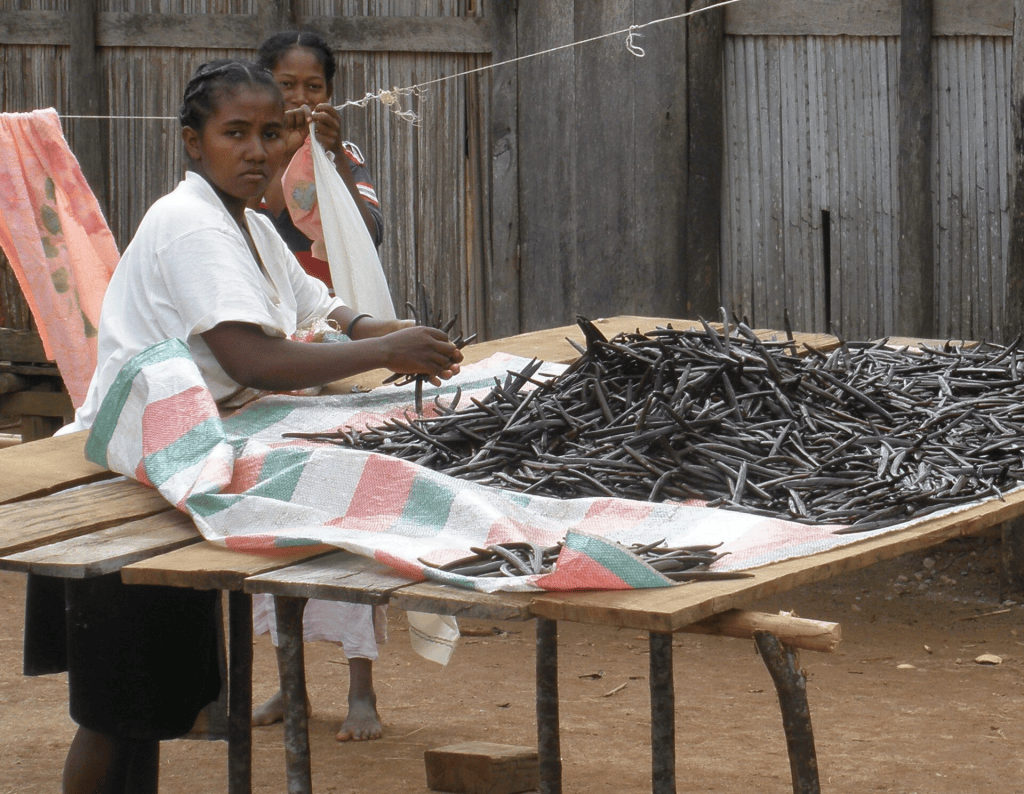
A Malagasy woman sorts vanilla beans in Sambava, northeastern Madagascar—part of the region at the center of the country’s vanilla industry. Photo: Lemurbaby, 2008, via Wikimedia Commons (CC BY-SA 3.0).
The United States is one of the major buyers.
So there is a decent possibility that the vanilla extract sitting in an American kitchen began its journey with a smallholder farmer in northeastern Madagascar.
That is a supply chain I would very much like to see firsthand.
One of the Most Unusual Places for Wildlife on Earth
And now we can finally talk about the lemurs.
Madagascar’s geographic isolation created an evolutionary laboratory unlike almost anywhere else on Earth.
A 2022 scientific review estimated that 89% of Madagascar’s native land vertebrate species are endemic, meaning they occur naturally nowhere else. When breeding birds are excluded, endemism among the remaining terrestrial vertebrates rises to about 97%. Approximately 99% of amphibians, 95% of reptiles, and all native primates—including lemurs—are endemic.[9]
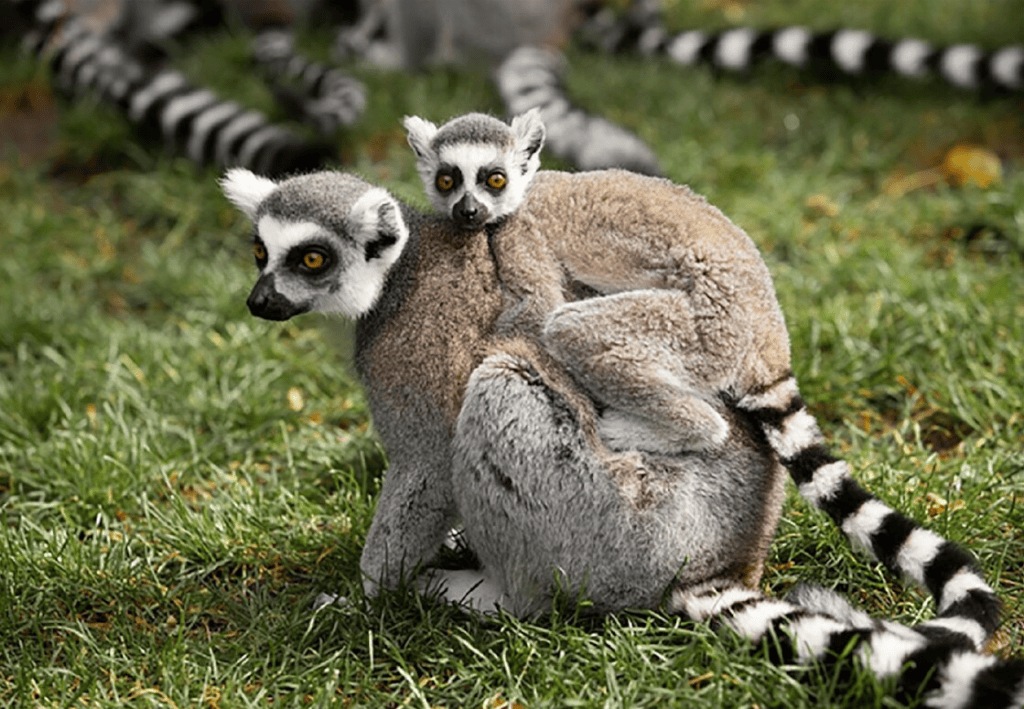
Ring-tailed lemurs (Lemur catta), one of Madagascar’s best-known endemic species. Photo: Marc Palmada-Flores et al., 2022, via Wikimedia Commons (CC BY 4.0).
Madagascar is home to:
- more than 100 species of lemurs
- an extraordinary variety of chameleons
- geckos
- tenrecs
- fossas
- hundreds of frog species
- thousands of unique plant species
Plant life is similarly distinctive. Approximately 82% of Madagascar’s described native vascular plants are endemic.[10]
Then there are the baobabs.
Madagascar contains six endemic species of baobab, making the island the center of the genus’s diversity.[11]
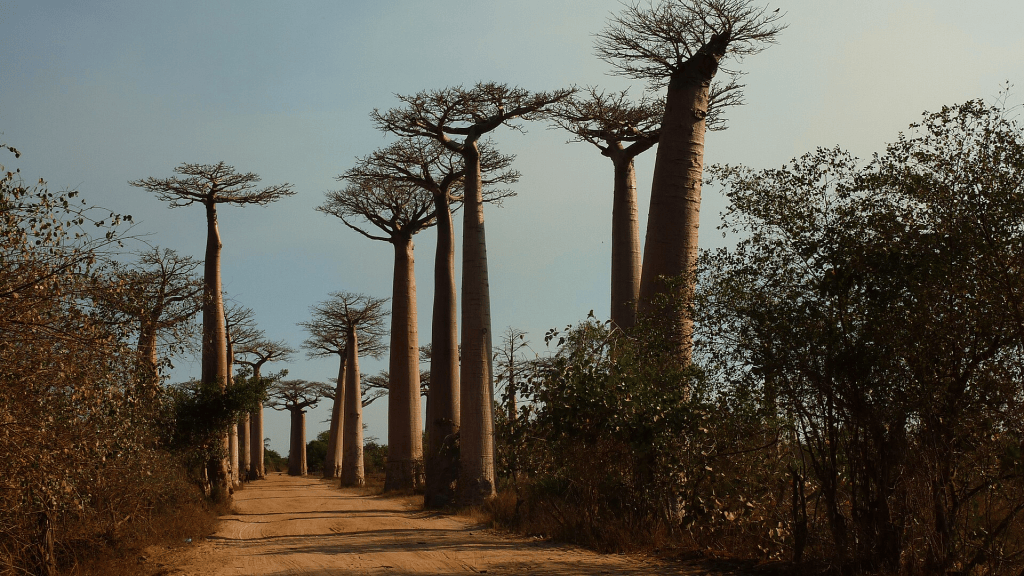
The Avenue of the Baobabs near Morondava in western Madagascar. These towering baobabs are among the country’s most recognizable landscapes and reflect Madagascar’s extraordinary plant endemism. Photo: Pasleim, 2012, via Wikimedia Commons (CC BY-SA 4.0).
In the south, the spiny forest contains bizarre-looking plants adapted to extremely dry conditions, including octopus trees and other species found nowhere else.
And here is one fact that surprised me during my preparation:
Madagascar does not have the kind of dangerously venomous land snakes that people often associate with tropical countries.
There are rear-fanged snakes with venom, but none of Madagascar’s terrestrial snakes are considered a serious threat to humans. Nor is Madagascar known for medically dangerous native spiders.
If I have to worry about a large wild animal, crocodiles are considerably more deserving of respect.
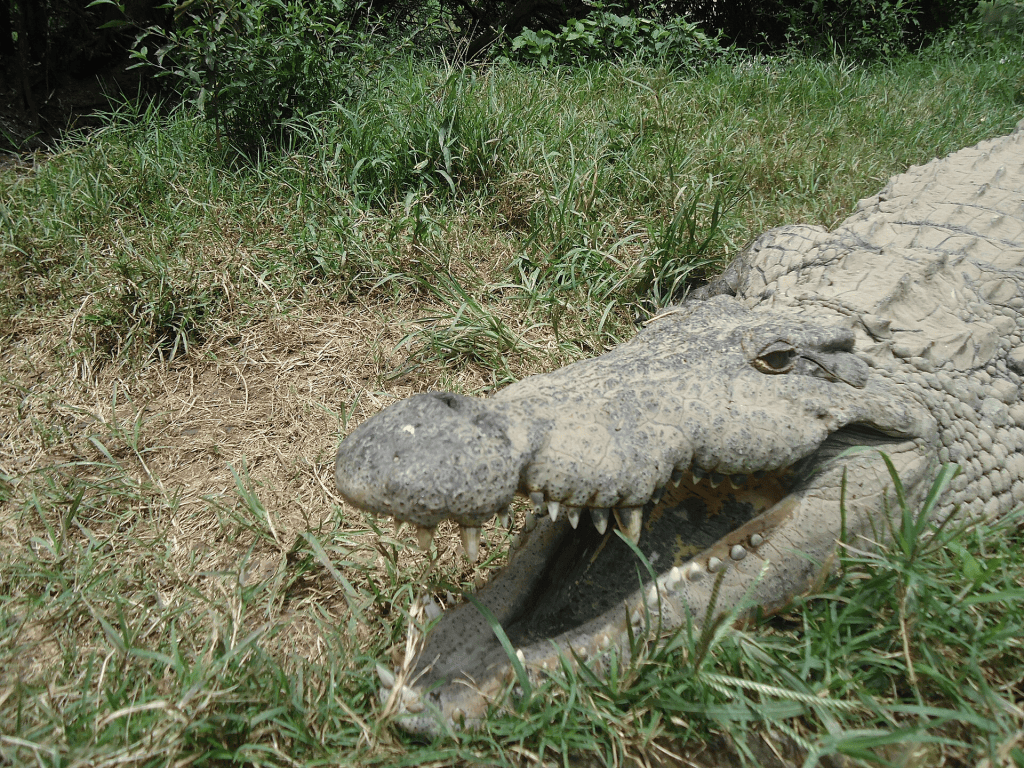
A crocodile in Madagascar. Crocodiles are among the island’s largest potentially dangerous wild animals. Photo: Samrina.riffi, 2015, via Wikimedia Commons (CC BY-SA 4.0).
So, ironically, one of the most biodiverse tropical countries on Earth is relatively free of some of the venomous animals people might expect to find there.
A Country With Enormous Natural Wealth—and Deep Poverty
That extraordinary natural wealth exists alongside serious economic challenges.
Madagascar remains one of the poorest countries in the world.
The World Bank’s most recent national poverty assessment found that 75.2% of Madagascar’s population lived below the national poverty line in 2022. Poverty was considerably higher in rural areas, where the rate reached 79.9%, compared with 55.5% in urban areas.[12]
That is important context for my Peace Corps assignment in food security.
It is also something I want to write about carefully.
Statistics about poverty are useful, but they can very quickly reduce millions of people to a single number.
Poverty is part of Madagascar’s reality, but it is not the entirety of Malagasy life.
People also have families, communities, businesses, farms, traditions, humor, ambitions, expertise, celebrations, frustrations, and ordinary daily lives.
One of my goals for this blog is to discuss development challenges without presenting the people I meet simply as recipients of aid or as statistics in a development report.
What Does Someone Earn in Madagascar?
Income statistics help put the economic differences between Madagascar and the United States into perspective, although they need to be treated carefully.
Madagascar has a very large informal economy, which means that a single national “average salary” does not describe people’s lives particularly well.
A national household survey covering 2021–2022 reported average worker earnings of approximately 196,000 ariary per month ($45.30 USD), while the median was only about 108,000 ariary per month ($24.96 USD).[13]
At the average level, that would equal roughly 2.36 million ariary per year ($545.40 USD).
Wages can vary enormously between rural and urban areas, formal and informal employment, different occupations, and different regions.
Formal statutory minimum wages can also be considerably higher than the incomes earned by many people working informally or in subsistence agriculture.
So these figures are best understood as broad economic context rather than a description of what a typical individual in Madagascar necessarily earns.
Ariary: Madagascar’s Currency
Madagascar uses the Malagasy ariary, abbreviated MGA and usually written as Ar.
As I am writing this in August 2026, one U.S. dollar is worth roughly 4,300 ariary.
So:
$1 ≈ Ar 4,300
$10 ≈ Ar 43,000
$100 ≈ Ar 430,000
The exchange rate moves constantly, so those numbers will certainly change during my service.
I suspect one of the adjustments during my first few months will be learning to stop mentally converting every purchase back into dollars.
What I Know—and What I Don’t
Everything I have written here is what I know about Madagascar before actually living there.
I know some of the geography, history, languages, crops, wildlife, and economic statistics.
I know where Madagascar is on a map and some of the forces that have shaped the country.
But I do not yet know what any of that feels like in everyday life.
I do not know what my permanent community will look like when I first arrive.
I do not know which crops will be growing around me, what the market will be like, what people will eat most often, or which local traditions will become part of my routine.
I do not know what Malagasy will sound like once it is no longer something I am studying, but the language of conversations happening all around me.
And I do not yet know which parts of Madagascar will become most important to me.
That is one of the reasons I wanted to write this post now.
It gives me a record of what I understood before I arrived—before facts from books and maps begin to be replaced by places, people, experiences, and relationships.
I expect that over the next 27 months some of what I currently understand will become more complicated. Some assumptions will probably turn out to be wrong. Things that seem important to me now may matter much less once I am there, while things I have barely thought about may become central to how I understand the country.
I hope that happens.
This blog is not meant to present me as an expert on Madagascar.
It is meant to document the process of becoming more familiar with a country that I am about to call home.
This is where that learning begins.
_____________________________________________________________________________________
Sources & Further Reading
[1] Permanent Mission of Madagascar to the United Nations. “Country Facts.” United Nations.
https://www.un.int/madagascar/madagascar/country-facts
[2] United Nations. “Madagascar.” UNData, 2025.
https://data.un.org/en/iso/mg.html
[3] Central Intelligence Agency. Madagascar Country Profile. The World Factbook, 2024 edition.
[4] Permanent Mission of Madagascar to the United Nations. “Country Facts: History.” United Nations.
[5] Reuters. “Madagascar’s military takes power, fleeing president impeached.” October 14–17, 2025.
[6] Primature de la République de Madagascar. “Nomination du Premier Ministre – 15 mars 2026” and “Membres du Gouvernement.” Government of Madagascar.
[7] Food and Agriculture Organization of the United Nations. East African Agriculture and Climate Change: Madagascar.
[8] Food and Agriculture Organization of the United Nations. Research on Madagascar’s clove- and vanilla-based agricultural systems.
[9] Goodman, Steven M. “Updated Estimates of Biotic Diversity and Endemism for Madagascar—Revisited After 20 Years.” Oryx 57, no. 5 (2023): 561–565.
[10] Royal Botanic Gardens, Kew. “Madagascar’s Extraordinary Biodiversity: Threats and Opportunities.”
[11] Madagascar Protected Areas / scientific literature on Adansonia diversity in Madagascar.
[12] World Bank. Madagascar Poverty and Equity Assessment: Navigating Two Decades of High Poverty and Charting a Course for Change. 2024.
[13] Institut National de la Statistique de Madagascar (INSTAT), household survey 2021–2022; reported worker income statistics.


.jpg)


Leave a comment